
The Playing-to-Win Strategy Canvas - A Practical Guide for Rural Hospital Leaders
Let's be honest about something most of us already know but rarely say out loud: the vast majority of hospital strategic plans are exercises in aspiration, not strategy. They produce beautifully formatted documents that sit in binders and on SharePoint sites, referenced during board meetings and forgotten everywhere else. For rural and Critical Access Hospitals operating with razor-thin margins and shrinking workforces, this isn't just wasteful — it's dangerous.
The problem isn't a lack of effort. It's a lack of framework. Most strategic planning processes in healthcare are built on tools designed decades ago for fundamentally different environments. SWOT analyses, for all their ubiquity, produce inventories of observations rather than actionable choices. Balanced scorecards measure execution of existing strategy but don't generate new strategic insight. And visioning exercises, while energizing in the moment, often produce aspirations disconnected from the hard choices required to achieve them.
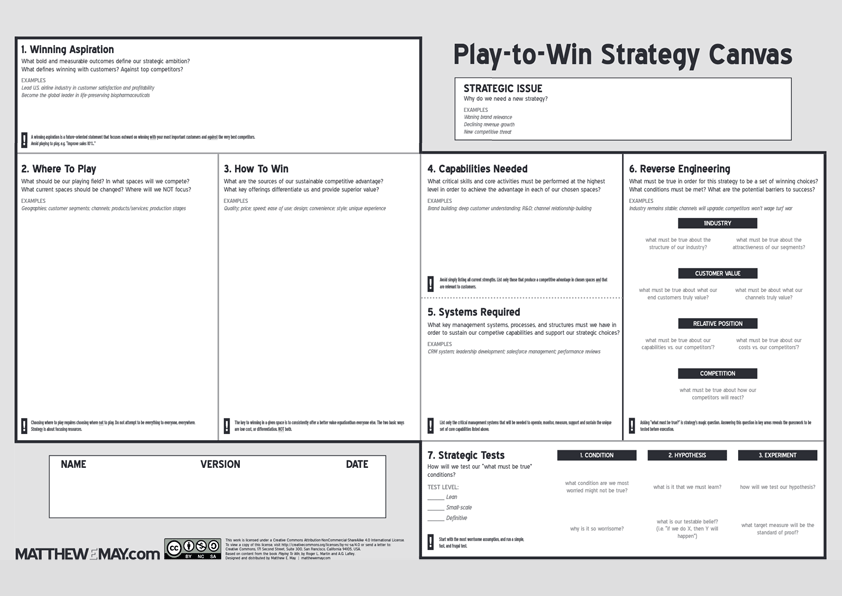
There is a better way. The Playing-to-Win Strategy Canvas, developed by Matthew E. May and built on the foundational strategic framework from A.G. Lafley and Roger Martin's Playing to Win: How Strategy Really Works, is a single-page tool that forces the kind of rigorous, integrated thinking that separates real strategy from strategic theater.
This is Part 1 of a two-part series. Here, we'll walk through the Canvas's first stage — Choice-Making — with practical examples that reflect the realities Critical Access Hospital leaders face every day. In Part 2, we'll cover Reverse Engineering and Barrier Testing, the stages that stress-test your strategy before you commit scarce resources.