
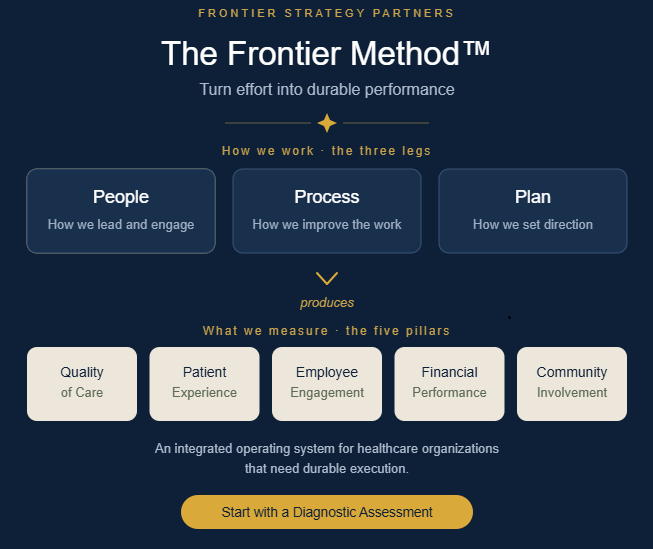
The Frontier Method™ - Turning Effort Into Durable Performance in Healthcare
Walk into almost any healthcare organization and you will find people working hard. Leaders are stretched across more responsibilities than the calendar can hold. Staff are giving more than the staffing model assumes. Boards are asking serious, well-informed questions. Dashboards are full of data. Strategic plans exist, often handsomely bound, and improvement projects are underway in half a dozen departments. And yet, in organization after organization, the same problems keep coming back. Strategic plans live in a binder while daily operations run on instinct. Improvement efforts launch with energy and quietly fade. Engagement surveys surface the same frustrations year after year, and the issues they name go unresolved. Quality, finance, patient experience, workforce, and community priorities are each reviewed in their own meeting, by their own committee, on their own cadence, rarely in the same room and almost never as one connected story.
The gap is not a gap in effort. It is a gap between effort and durable performance, and that is the gap the Frontier Method was built to close.
The Frontier Method is a management system for healthcare organizations that need durable execution. Rather than adding one more initiative to an already crowded agenda, it integrates the disciplines most organizations already practice, including leadership and engagement, process improvement, strategic planning, performance measurement, and board oversight, into a single coherent operating rhythm. The simplest way to express its value is this: the Frontier Method helps healthcare organizations turn leadership effort, improvement work, strategic planning, and performance measurement into one integrated operating system.
We want to be honest about what is and isn't novel here. The Method does not claim that rounding, Lean, A3 problem solving, daily huddles, strategic planning, scorecards, or board reporting are new ideas. Each of these is well established. Our contribution is the integration of these familiar disciplines into one healthcare specific operating system, so that they reinforce one another instead of competing for attention in separate lanes.

Building Excellence in Healthcare Through a Comprehensive Management System
Exceptional performance is rarely achieved through isolated initiatives or the heroic efforts of individuals. Instead, sustainable excellence requires a comprehensive management system that aligns people, processes, and strategic direction. Having observed this healthcare transformation effort, I've become convinced that the "three-legged stool" approach—integrating People, Process, and Plan—offers a powerful framework for healthcare organizations seeking to elevate performance across all dimensions.
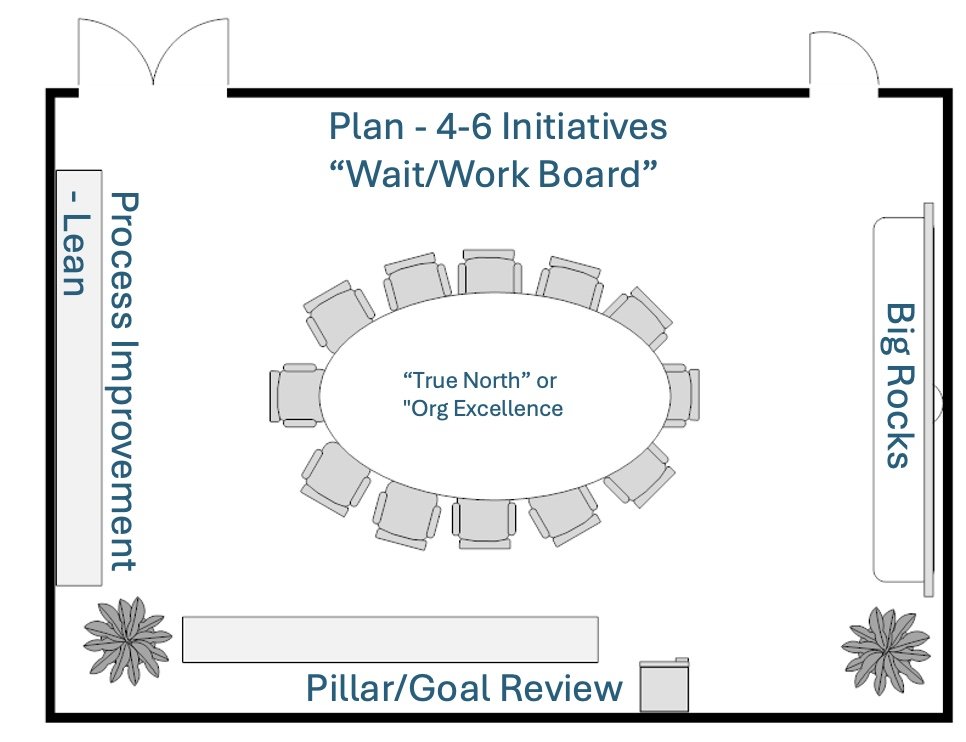
Managing People, Process, and Plan - A Systematic Approach to Organizational Success
In many healthcare organizations, the key to achieving success lies in effectively managing People, Process, and Plan. To truly harness this triad, it requires a disciplined, structured approach that keeps the entire team aligned with the organization’s mission, strategic goals, and improvement initiatives. One highly effective method for maintaining this alignment and keeping progress on track is what I call the "Around-the-Room Review."
This blog will explore how to set up a structured review process by utilizing the physical layout of a room to track progress and address key strategic priorities in a systematic way.

The Power of Organizational Culture: How Strong Culture Elevates Staff Relationships and Patient Care
In healthcare, we often focus on clinical outcomes, patient satisfaction scores, and operational efficiency. But beneath these metrics lies something fundamental to every hospital’s success: its culture. A strong organizational culture isn’t just a buzzword—it’s the very foundation that supports positive staff relationships and enhances the quality of care patients receive.
When a hospital or healthcare organization fosters a healthy, supportive culture, the effects ripple through every aspect of the organization, from staff morale to patient outcomes. In contrast, when culture is neglected, even the best clinical practices can falter under the weight of disconnection and discontent.