
Differentiation Isn't a Feature List: Using Playing to Win to Operationalize Porter in a Rural Hospital
There is a familiar exercise that plays out in hospital boardrooms across rural America. A consultant or a new CEO gathers the leadership team and asks what makes the hospital different. The flip chart fills up quickly: we know our patients by name, we have great nurses, we're committed to the community, we offer compassionate care, we're investing in technology, we're recruiting new specialists. Everyone nods. The list goes into the strategic plan. A year later, margins are worse, the regional system across the county line has bought another physician practice, and nobody can quite explain why the strategy isn't working.
The reason is that almost nothing on that flip chart is strategy. It is, in Michael Porter's terms, a description of operational effectiveness wearing strategy's clothes. And it is precisely the trap that independent rural hospitals fall into when they try to compete with regional systems by becoming smaller, friendlier versions of them.
This post is about how to escape that trap. It combines two of the most useful frameworks in modern strategy, Michael Porter's 1996 essay What Is Strategy? and A.G. Lafley and Roger Martin's Playing to Win (2013), and applies them to one of the hardest strategic environments in American business: the independent rural hospital. The focus throughout is on differentiation, because differentiation is where Porter is sharpest, where rural hospitals are most confused, and where the combination of these two frameworks does its best work.
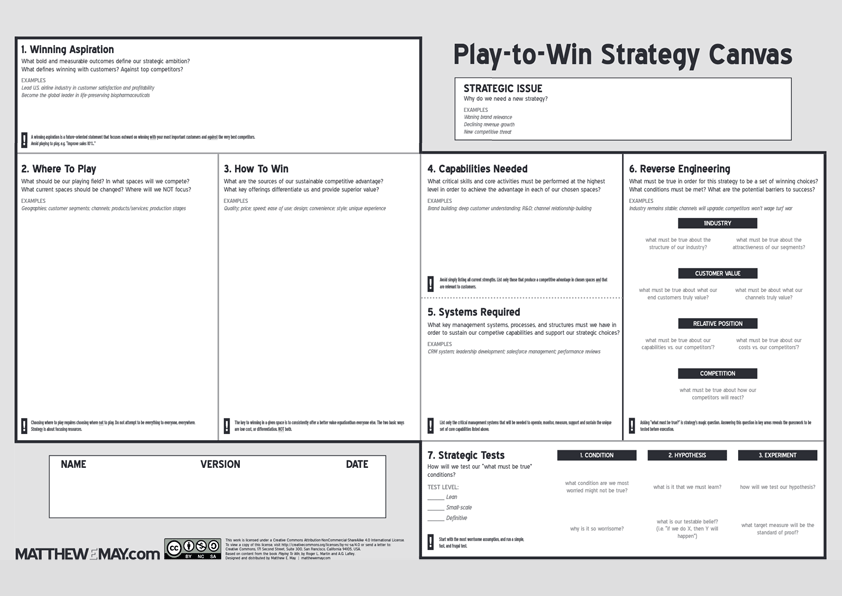
The Playing-to-Win Strategy Canvas - A Practical Guide for Rural Hospital Leaders
Let's be honest about something most of us already know but rarely say out loud: the vast majority of hospital strategic plans are exercises in aspiration, not strategy. They produce beautifully formatted documents that sit in binders and on SharePoint sites, referenced during board meetings and forgotten everywhere else. For rural and Critical Access Hospitals operating with razor-thin margins and shrinking workforces, this isn't just wasteful — it's dangerous.
The problem isn't a lack of effort. It's a lack of framework. Most strategic planning processes in healthcare are built on tools designed decades ago for fundamentally different environments. SWOT analyses, for all their ubiquity, produce inventories of observations rather than actionable choices. Balanced scorecards measure execution of existing strategy but don't generate new strategic insight. And visioning exercises, while energizing in the moment, often produce aspirations disconnected from the hard choices required to achieve them.
There is a better way. The Playing-to-Win Strategy Canvas, developed by Matthew E. May and built on the foundational strategic framework from A.G. Lafley and Roger Martin's Playing to Win: How Strategy Really Works, is a single-page tool that forces the kind of rigorous, integrated thinking that separates real strategy from strategic theater.
This is Part 1 of a two-part series. Here, we'll walk through the Canvas's first stage — Choice-Making — with practical examples that reflect the realities Critical Access Hospital leaders face every day. In Part 2, we'll cover Reverse Engineering and Barrier Testing, the stages that stress-test your strategy before you commit scarce resources.

Cascade of Choices - Understanding the Five Essential Questions of Strategy
Strategy doesn't have to be mysterious or overwhelming. At its core, strategy is about making specific choices to win in the marketplace. A.G. Lafley and Roger Martin present a clear framework built around five essential questions that form what they call the Strategic Choice Cascade.